ProductsDocumentationHow we make thingsSupport
Join the Discord
In review on BuiltByBitRoblox game kit · Roblox Studio

Wayfold Co-op tower defense

Draft the map. Defend the Keep. A co-op Roblox game with its full source, ready to make your own.

You and up to three friends defend a Keep on a tabletop of hexagonal tiles. Every wave you draft a terrain tile and lay it where it bends the enemies’ road and powers the towers beside it. The full source is yours.

24.99 USDone-time, on BuiltByBit
In review on BuiltByBit Play the live game
Roblox1 to 4 playersPhone, pad, mouseEnglish and French
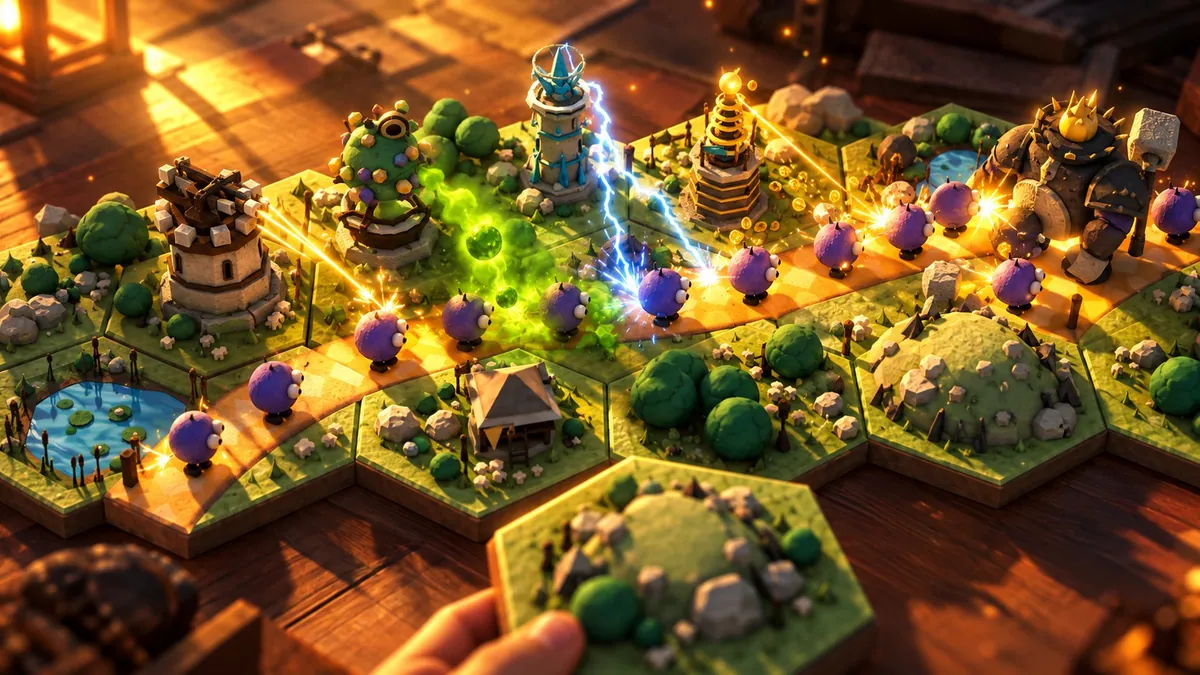
A hand holds a hexagonal hill tile over a tabletop board of hex tiles in warm lantern light: round purple enemies walk a sandy road, towers fire golden bolts, lightning and a green poison cloud, and an armoured boss with a stone hammer walks at the right.
Key art (illustration): a hand lays a hill tile while the towers hold the road; the game itself looks simpler.

Why it is good

What it does, concretely.

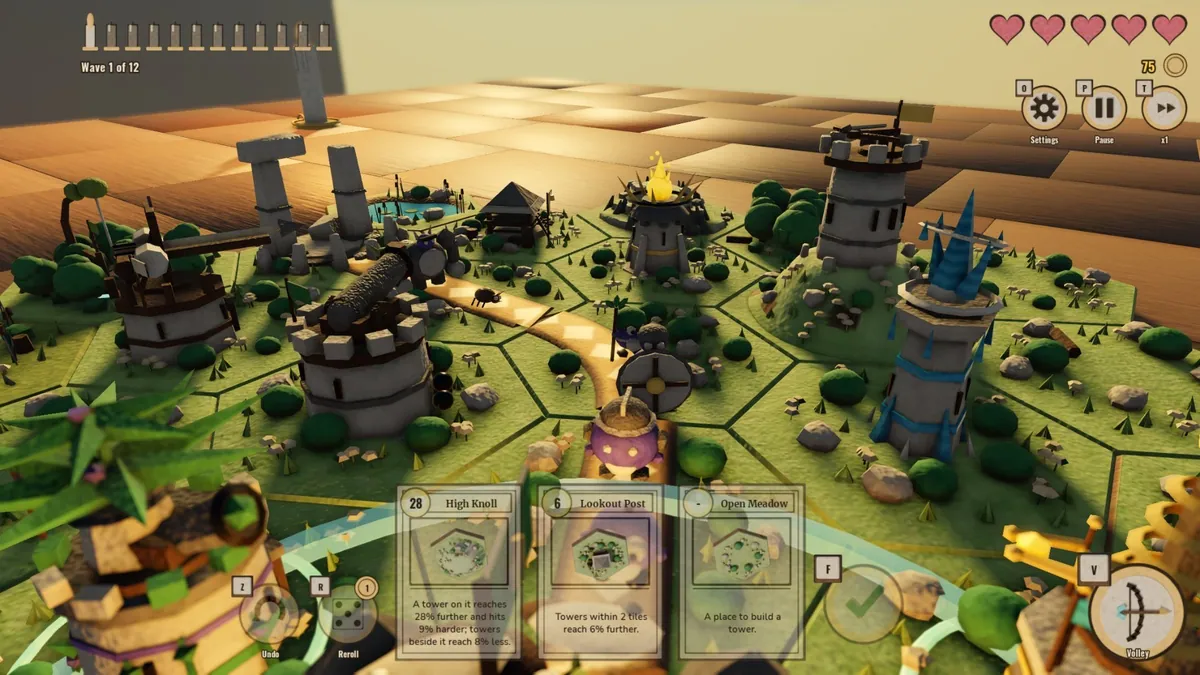
The board under a wave counter reading Wave 1 of 12, five hearts and 75 gold, with three tile cards at the bottom: High Knoll (towers on it reach further and hit harder, towers beside it reach less), Lookout Post (towers within two tiles reach further) and Open Meadow, and the buttons Undo, Reroll, Ready and Volley.
In-game capture: the draft: a hand of three terrain tiles, the High Knoll chosen, its effect written on the card; a staged state.

Draft the road

Nine kinds of terrain tile, a hand of three every wave. An Old Grove lends range, a High Knoll lifts one tower onto high ground, a Bog poisons the road beside it at the price of reach, a Lookout Post stretches the reach of every tower within two tiles, and a Winding Road or a Fork makes the enemies walk further. The server refuses any tile that would cut the road between the Gate and the Keep, and the preview you see uses the same rule. Then the wave comes, and the board you built decides who lives.
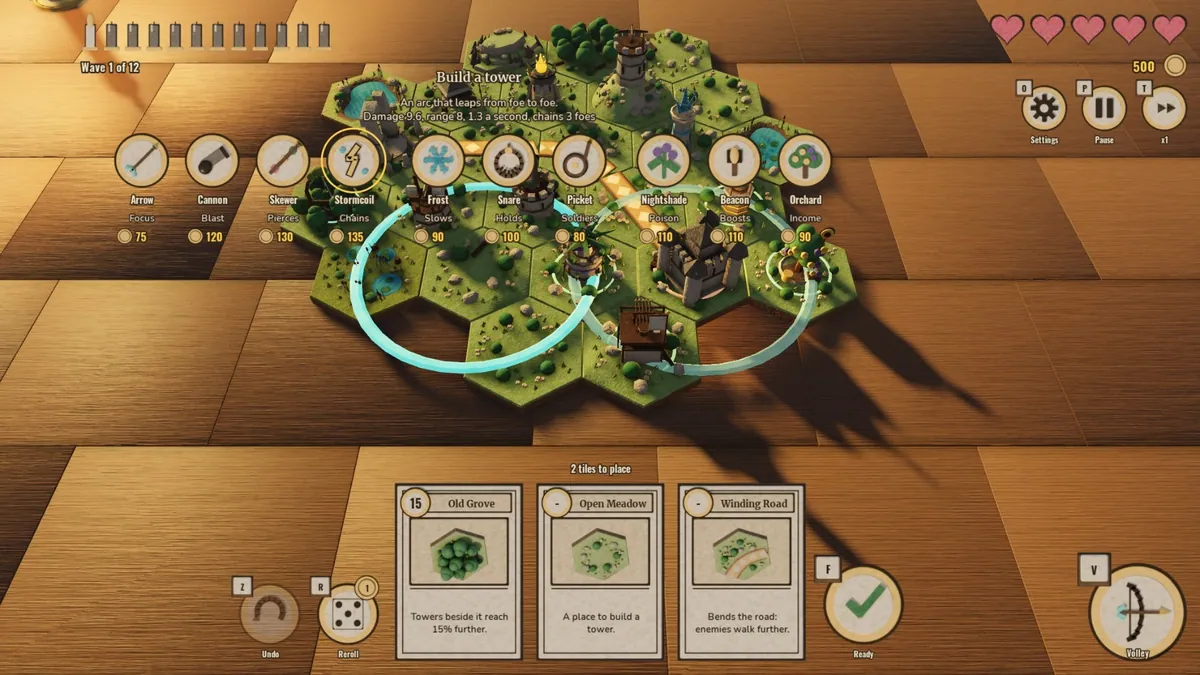
A row of ten round tower medallions with their names, jobs and prices (Arrow, Cannon, Skewer, Stormcoil, Frost, Snare, Picket, Nightshade, Beacon, Orchard), the Stormcoil selected with its damage, range, rate and chain, two cyan range rings on the board, 500 gold, and two tiles left to place.
In-game capture: the build menu: ten towers with a price each; a first tap shows a tower’s figures and its reach on the board, a second builds it. The game’s own camera.

Ten towers that break the rules one at a time

Arrow, Beacon, Cannon, Frost, Nightshade, Orchard, Picket, Skewer, Snare and Stormcoil: a chain of lightning, poison clouds, a bolt that pierces a whole file, a trap the road carries, a garrison that holds it, an orchard that pays gold. Each has a tier ladder and a choice of two final forms, twenty in all. The build menu holds the ten in three rows by job, reachable in two moves by pad, arrow keys or finger, and the tile under a tower decides how well it does its job.

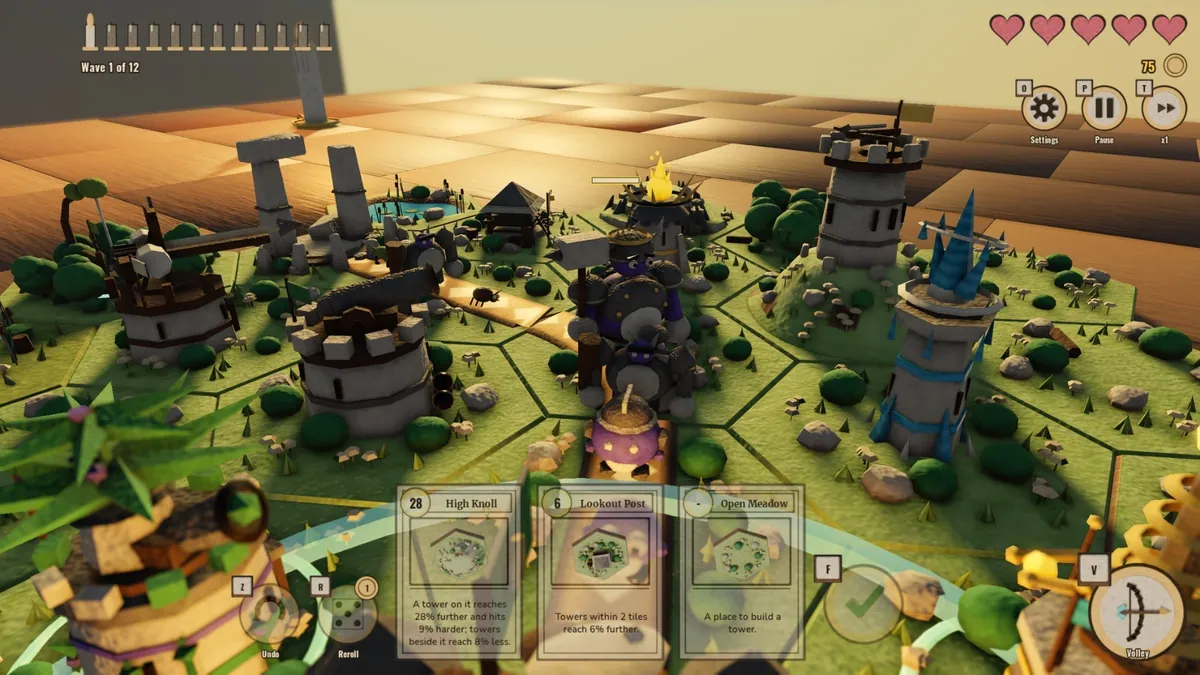
A hulking armoured figure with a stone hammer walks the road between towers, among smaller round enemies, with the draft cards at the bottom.
In-game capture: the Warden, the boss, walks the road among the walkers; a staged state, seen from a free camera.

Nine kinds of enemy, one of them a boss

Walkers, armoured walkers, scurriers that hunt your hero instead of the road, swarms, brutes, menders, shieldbearers, gliders and the Warden, the boss, over twelve waves on a board of radius five. The enemies’ health and the gold scale with the size of the party. Each player has a hero with a shot, a volley on a cooldown and a grip that fetches the gold the enemies drop.

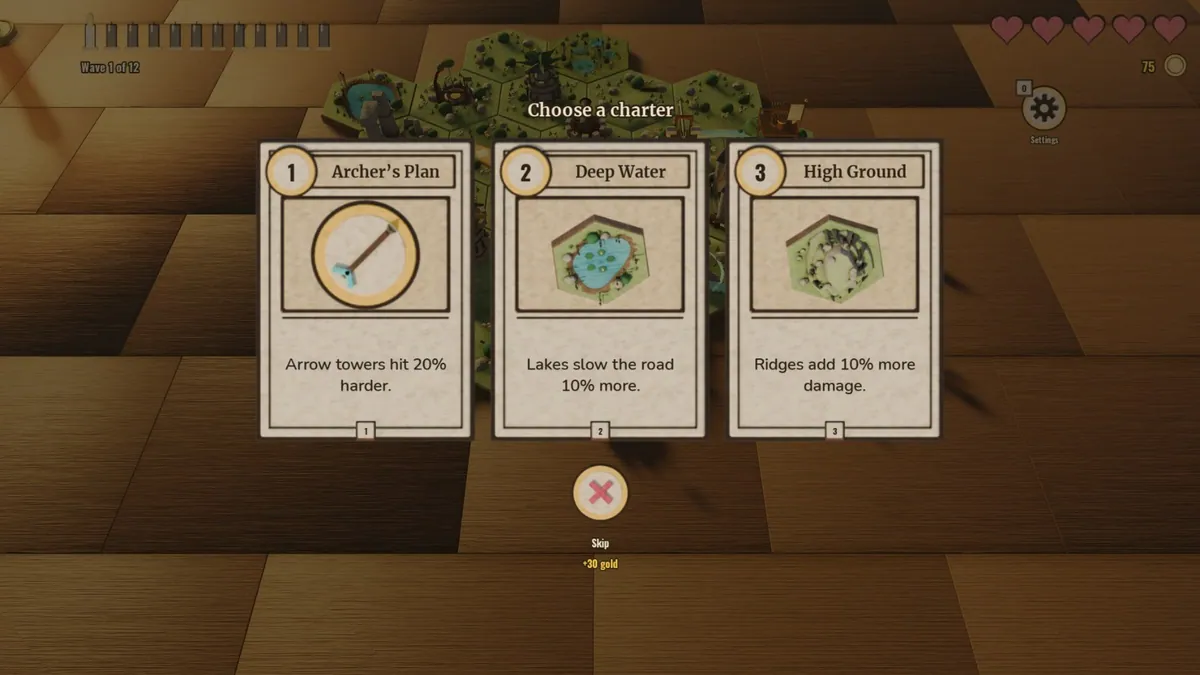
Three cards under the title Choose a charter: Archer’s Plan (arrow towers hit 20% harder), Deep Water (lakes slow the road 10% more) and High Ground (ridges add 10% more damage), and a red Skip button worth 30 gold.
In-game capture: after every third wave the party picks one of three charter cards, or skips for gold. The game’s own camera.

A run, the Daily and Endless

Twenty-five charter cards are offered three at a time after every third wave and after a boss, each bending one rule for the rest of the run, or skipped for gold. A run is twelve waves; the Daily is one seed a day, the same for every player in the world; Endless goes on until the Keep falls. Above the plain run, a Fray ladder of three rungs opens as you win, each rung adding a rule. Sparks are earned at the end of a run, and a codex keeps the enemies you have met.

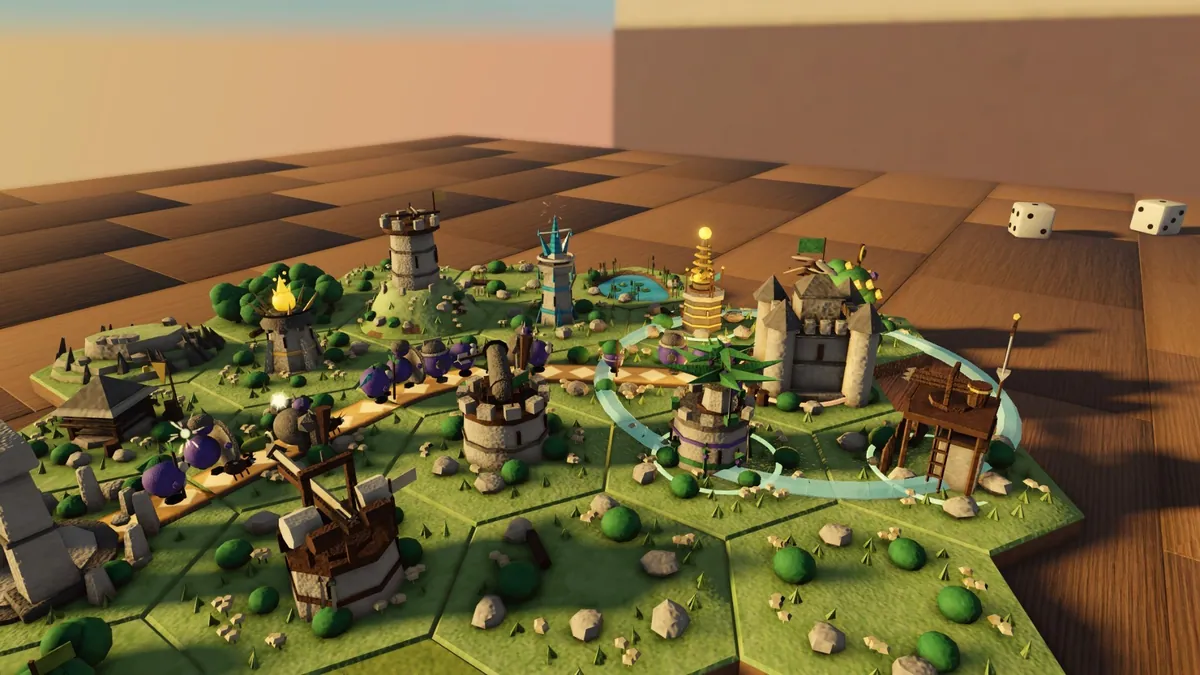
Hex tiles on a wooden table with dice: stone towers (an arrow tower on a hill, a blue crystal spire, a golden spiral beacon, a cannon, a palm-like tower, a fire brazier), the Keep, a pond, round purple enemies on a checkered road and a pale ring of range.
In-game capture: the tabletop board with ten towers raised on its tiles and enemies walking the road; a staged state, seen from a free camera.

Better together

Every player who joins has a table and a run of their own at once, with a bot ally when alone. Invite a friend who is in the server and the table grows to as many as four, with the same board for everyone, a shared Ready and a lobby where the host picks the mode and the Fray. The table stays together between runs.

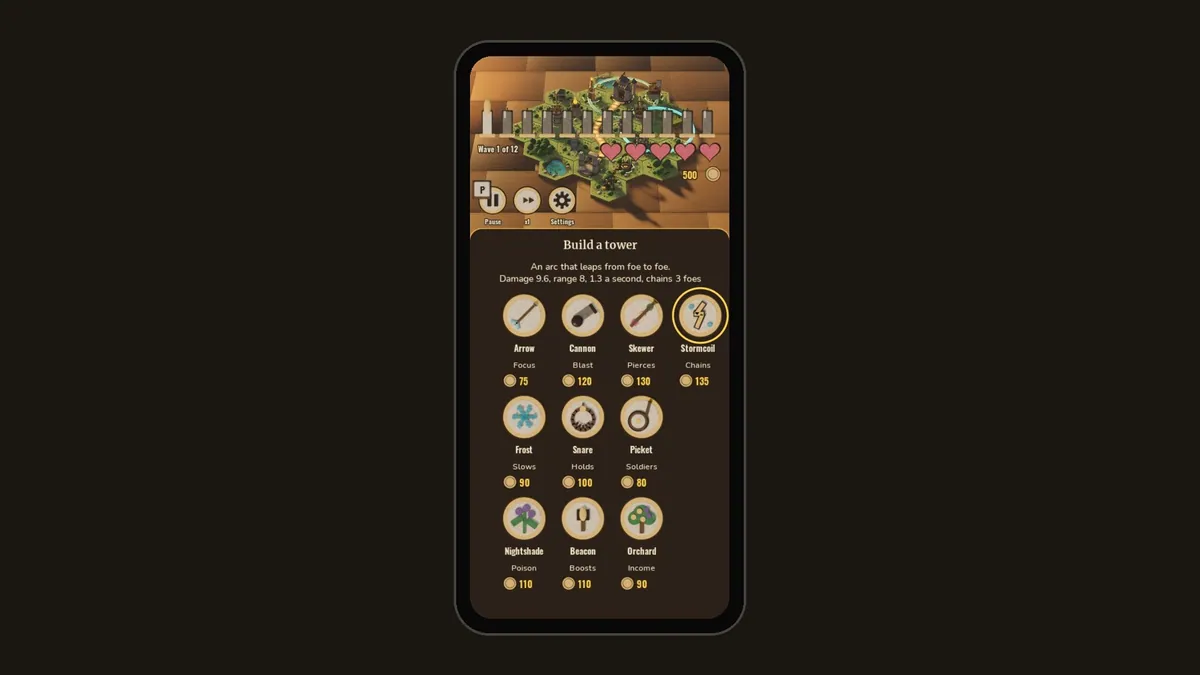
A drawn upright phone frame: the board at the top, then a Build a tower panel with ten tower medallions in rows of four, three and three, each with its price, the Stormcoil selected.
In-game capture: the build menu on a phone held upright, taken in a 390 × 844 Studio window and shown in a drawn frame: three rows of towers, one thumb. Not a photo of a real phone.

Plays where your players are

Touch in portrait and landscape, mouse and keyboard, and a gamepad, laid out for phone, tablet, PC and a TV: roomy taps, a safe margin on TVs, a pad’s own glyphs and its focus on every screen, one-hand reach. A tile is placed by a drag or by two taps. The rules are a pure function of the seed and the players’ actions, so a run replays exactly and the Daily is the same for everyone, and the server decides progress, currency and items.

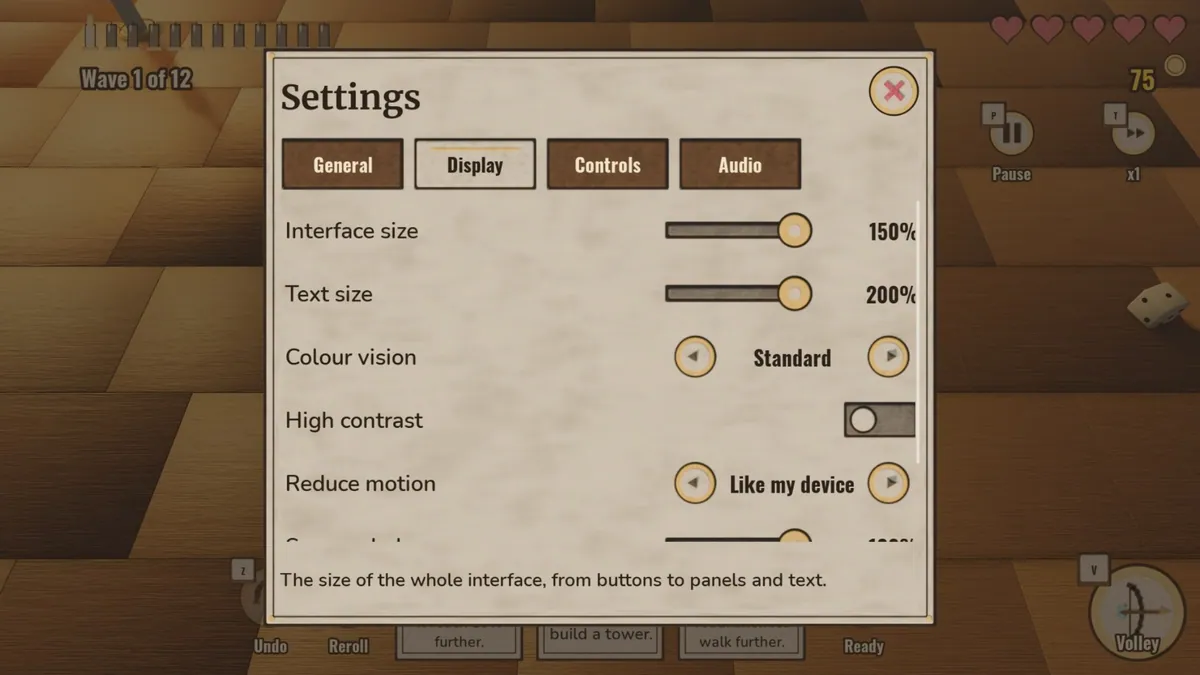
A Settings panel on its Display tab, with the tabs General, Display, Controls and Audio and the rows Interface size 150%, Text size 200%, Colour vision Standard, High contrast off and Reduce motion Like my device, the values pressed against the panel’s right edge.
In-game capture: Settings, display tab, at the largest sizes the game offers (interface 150 %, text 200 %); at these sizes the value labels and one switch touch the panel’s edge, a defect on the developer’s list.

Everyone can play

Text up to 200 percent, an interface size, a high-contrast option, colour-vision palettes, reduced motion, sound captions and a left-handed layout, with every word in English and French (396 texts). The picture shows the largest sizes, where the value labels touch the panel’s edge: a defect on the developer’s list, said here as on the listing.

The art

The art you build, and what it looks like built.

The captures on this page show the game with its art built. The package ships the Blender and Python scripts that build every model, texture, icon and effect, and a tool that uploads them to your own Roblox account. These are Blender renders of the game’s own models.

In the box

What you get, and what you do not.

Included

  • The whole game as a Rojo project: its code, its tests and every data file, as plain Luau you can read, unobfuscated and DRM-free, and the built place file Wayfold.rbxl
  • Every Roblox id the game uses in one file (blank in your copy: the game builds and plays without them) and every tuning number in another: the length of a run, tower costs, ranges and damage by tier, the final forms, the enemies, the waves, the tiles’ effects and the party’s scale
  • 9 terrain tiles, 10 towers with 20 final forms, 9 enemy kinds, 25 charter cards, 3 modes, 3 Fray rungs and 12 waves, counted from the data by a script of the package, with 396 texts in English and French; a new language is a column in Strings.csv
  • The Blender scripts that make every model, atlas, flipbook and glyph, the scripts that synthesise the game’s 299 sound files, and the tools that upload them to your own Roblox account
  • A gate that checks your copy in one command: format, lint, types, 83 test suites, the balance simulations (bots that play the real rules from fixed seeds) and the place build, 718 seconds on the developer’s machine; the fast pass runs 81 suites in 281 seconds
  • README, install and configuration guides, the licence, a changelog and a credits page for everything that is not ours, and LICENCE_CHECK.md, which says what the advisory licence check sends

Not included, said plainly

  • The built art. You build it: the package ships the scripts that make every model, atlas, flipbook and glyph (144 uploads: 79 models and 65 images) and the tools that upload them to your own Roblox account, plus the 299 sound files the game’s scripts synthesise, which you upload too; none of the developer’s own art or ids is in it. Until built, the game builds and plays with nothing drawn from art, so it can be run, tested and changed on day one. Expect hours of Blender and upload time, plus Roblox’s moderation.
  • Your own experience, your Roblox account, its products and passes, and your Open Cloud API key: you create those. The game sells nothing, and nothing in it is wired to a purchase.
  • The developer’s experience, its store images and page texts.
  • Other people’s play: the game has no player numbers yet, and its balance comes from simulations, not from crowds.
  • A finished game by the developer’s own measure. 14 of the 17 rows of the developer’s completeness table are under the floor the developer set for a finished game: landscapes 1 of 2, terrain tiles 9 of 12, enemy kinds 9 of 18, elite enemy kinds 0 of 4, bosses 1 of 3, heroes 1 of 3, charter cards 25 of 60, Fray rungs 3 of 7, relics 0 of 36, run events 0 of 16, trials 0 of 8, feats 0 of 30, story beats 0 of 12 and cosmetic looks 0 of 30. The other three rows are at or past their floor.

Where to buy

Try it first, then buy it once.

Try it first

Play the live game

The game itself is free on Roblox, with its art built — the kit can be one release behind it.

Requirements

Tools
Roblox Studio and a Roblox account; a shell (Git Bash on Windows, macOS or Linux); Rokit, which installs Rojo, Lune, StyLua, Selene, luau-lsp and uv; Blender 5.2 to make the art; an Open Cloud API key to upload it
Players
1 to 4 at a table; every player who joins has a table of their own
Devices
Phone and tablet (portrait and landscape), PC, gamepad and TV
Languages
English and French
Delivery
Sold and delivered by BuiltByBit; an optional licence key and a client-area copy; an advisory licence check
How delivery works
BuiltByBit sells and delivers Wayfold: you download the package from your BuiltByBit account and it works as it is. A licence key is optional: ask the developer for yours and your client area gives you a copy of the kit with the key already written in it. The kit carries an advisory licence check that only ever writes a line to your server’s output, and LICENCE_CHECK.md in the package says exactly what it sends.

How it was made

Said the same way here and on the listing.

Each BuiltByBit listing carries a disclosure about how its product was made. We reproduce it word for word, so this site never says anything the listing does not.

How it was made

The listing’s text

The game was designed and directed by its developer. The code, the tests, the Blender scripts, the sound generators and the game’s texts (the names, the cards’ words, the tips, in English and in French) were written by an AI coding assistant (Claude Code) under that direction, then checked by automated tests and a gate that runs on every change. No AI-generated image, texture or 3D model is inside the product: every visible object comes from a Blender script, and the game’s sounds are synthesised by scripts.

About the pictures

The listing’s text

Eleven pictures on this page are captures of the running game in Roblox Studio, with its art built. They are staged states, not recorded play: the towers are placed and the enemies put on the road for the shot, and most are seen from a free camera framed for the picture, while the game’s own camera shows the board smaller. The two phone pictures are Studio’s phone windows shown in a drawn frame, not photos of a real phone, and the numbers on the summary card are an example. Three pictures are Blender renders of the game’s own models, made by the scripts in the package. The opening picture and the link-preview image are key art: illustrations made with an image model (ChatGPT Images) from the game’s own captures and renders, labelled as such, and the game itself looks simpler.

Questions

Before you buy.

Do I get the art?

You get the scripts that make it. The package ships the Blender scripts that build every model, atlas, flipbook and glyph, the 299 sound files and the scripts that synthesise them, and the tools that upload them to your own Roblox account. The captures on this page show the game with its art built. Until you build it, the game builds and plays with nothing drawn from art.

Can I play it before I buy?

Yes. The live game is free on Roblox: it is the game the kit is made from, with its art built, and it sells nothing. The kit can be one release behind it.

How was it made?

The developer designed and directed it. The code, the tests, the Blender scripts, the sound generators and the game’s texts were written by an AI coding assistant (Claude Code) under that direction, then checked by automated tests and a gate. No AI-generated image, texture or 3D model is inside the product. The disclosure further down is the listing’s own, word for word.

Is anything in it not made by you?

One library, named: ProfileStore (Apache 2.0), which keeps the saves, ships with its licence text. The surfaces are painted by the Blender scripts from node setups in code, and all 299 sounds are made by the package’s own scripts: no photograph, scan, texture library or recording of anyone’s is used. The credits page lists it all.

Does the game call anything outside Roblox?

One call, disclosed: once per server, a short while after it starts, the kit asks the seller’s licence service whether its key is known. The check is advisory: it never touches a player, never switches a feature off or changes your data, does nothing in Studio, and can be turned off by deleting one script. LICENCE_CHECK.md says exactly what it sends. The game also sends its events to Roblox’s own analytics.

How much can I change?

The game is data. Every tuning number is in one file, every Roblox id in another, and the tiles, towers, enemies, charter cards and the texts in both languages are data files you can read and change; a new language is a column in Strings.csv. After a change, one command runs the gate, and a balance simulation plays the real rules from fixed seeds to show whether the expert bot still wins inside the bands the developer chose. The code is plain Luau.

What is smaller than it should be?

Most of what a game of this kind holds, by the developer’s own count. The developer keeps a table of what a complete game of this kind holds, with a minimum set for a finished game, and 14 of its 17 rows are under it: one landscape, nine terrain tiles, one hero, one boss, 25 charter cards and 3 Fray rungs, and no relics, run events, trials, feats, story, cosmetic looks or elite enemies yet. The roadmap goes on to fill them; what you buy is the game as it stands, and it is smaller than its developer wants it to be.

What has not been proven?

The game has been played by its developer; it has no player numbers yet, and its balance comes from simulations, not from crowds. A real gamepad, a real phone and the sounds heard by a person were not part of the developer’s checks, and a server with fifty runs at once was not run. Open defects are on the developer’s list, and none stops a run: on a PC at the game’s own camera the board fills about a quarter of the frame; the cards sit on busy wood; held upright on a phone the three draft cards show no names or effects and the buttons sit on the board; the Marsh reads like a meadow with ponds; several tower shots reuse the shapes of simpler ones (the Skewer’s bolt, the Stormcoil’s arc, the Nightshade’s cloud and the Snare have no art of their own); in the developer’s simulations a party of two wins more often than the design target, the Frost does very little of the damage and the Skewer and Stormcoil lines are weak at the top Fray level; the build menu of ten towers does not fit the smallest screens at the largest text sizes; at the largest settings on a PC the display tab’s value labels and one switch are cut by the panel’s edge; the first two seconds of a session freeze the picture three times in the developer’s engine.

Are the updates free?

Yes, for life, as on every Botera product. The listing’s support terms are the ones BuiltByBit shows on it.

Questions before or after you buy?

The developer answers on the Discord. There is no support queue and no reseller in between.