ProductsDocumentationHow we make thingsSupport
Join the Discord
Available nowRoblox game kit · Roblox Studio

Cutstring Roguelike deckbuilder

Cut every string, and the monster fights for you. A Roblox game with its full source, ready to make your own.

A troupe of living marionettes fights card battles on a theatre stage whose sets change with every act. You and up to three friends play the troupe, and the full source is yours.

49.99 USDone-time, on BuiltByBit
Roblox1 to 4 playersPhone, pad, mouseEnglish and French
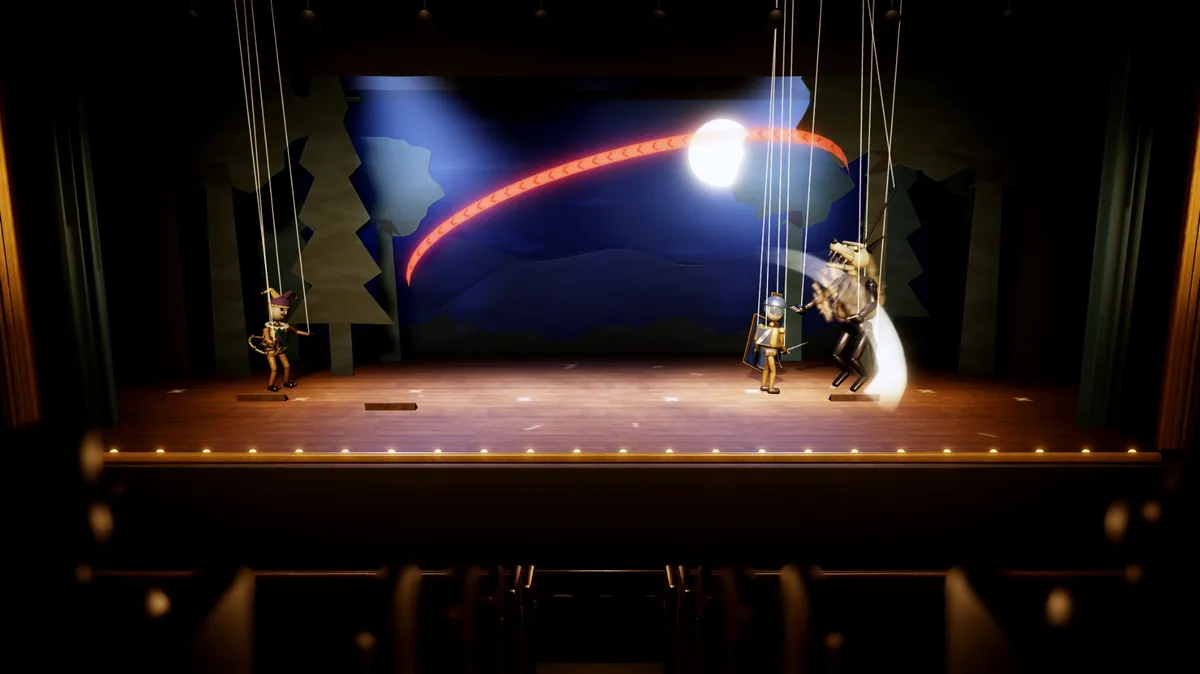
A marionette on strings slashes a wolf on a small theatre stage with a painted forest, a spotlight and a red arc of motion.
In-game capture: the Guard’s slash on the wolf, on Act I’s set, with the interface hidden.

Why it is good

What it does, concretely.

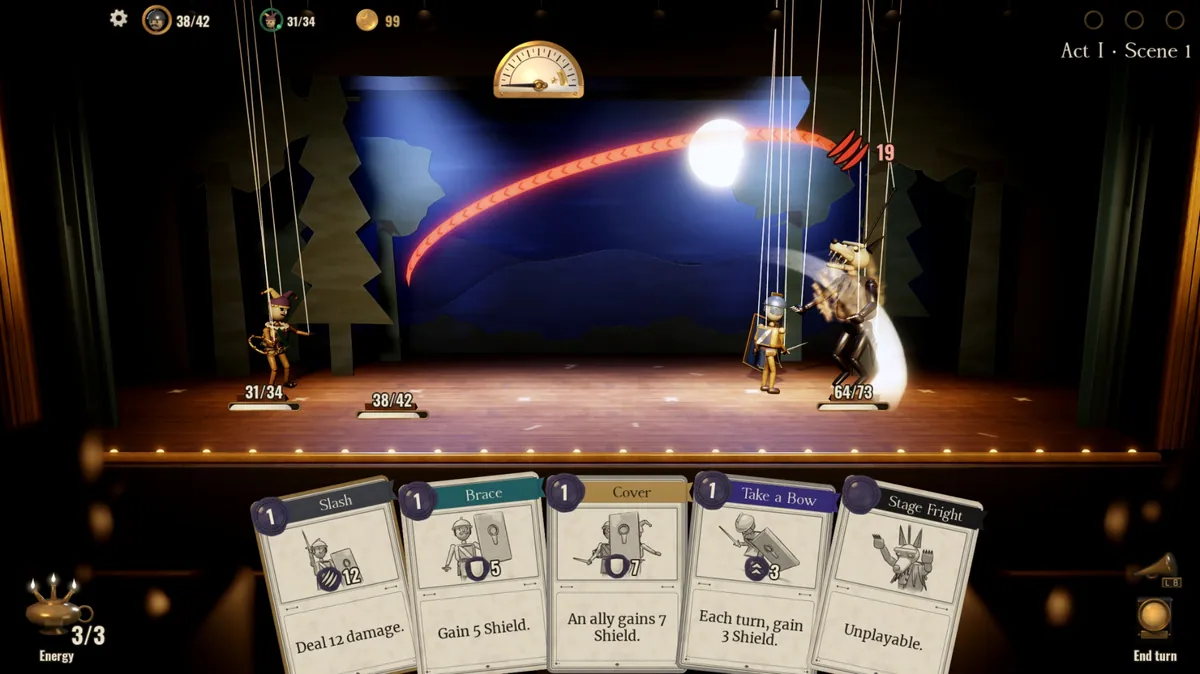
A fight on the stage: two puppets on strings, a wolf hit by a slash that shows the number 19, a hand of five cards at the bottom and the energy lamp.
In-game capture: a card played on its target: the Guard’s Slash lands on the wolf.

Cut the strings

Every enemy hangs on strings: cut one, and when you have cut them all the monster turns on its own side. 18 kinds of enemy in 51 encounter groups over two acts, with a boss at the end of each; a boss crashes to the stage instead of changing sides.

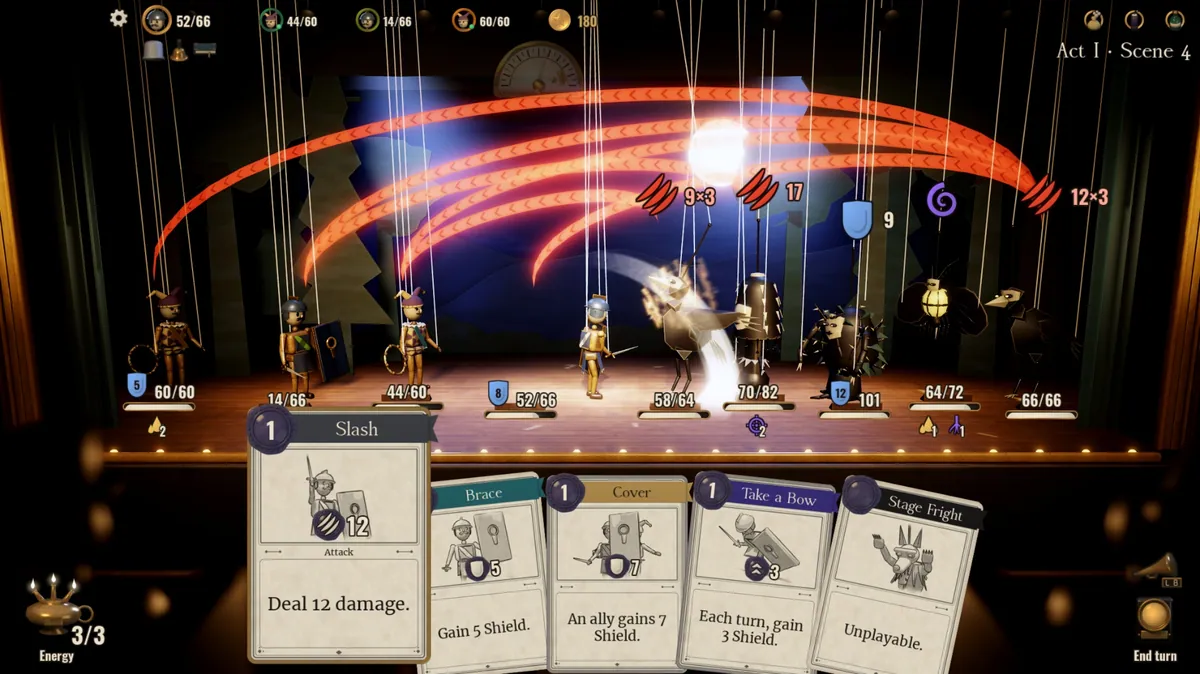
A card named Slash lifted above a hand of five cards, reading Attack and Deal 12 damage, with four puppets and five enemies on the stage.
In-game capture: a card lifted from the hand: its illustration, its type and what it does.

Three puppets, a hundred cards

The Guard, the Trickster and the Mender each have a kit and a card list of their own (85 cards between them), and 12 troupe cards act on your allies. 50 props with families that build on one another, 12 tricks, 24 improvised scenes and 16 stage directions (six are a season’s own) change every run, over ten Critics levels that are ten different sets of rules, over a map of scenes made from a seed.

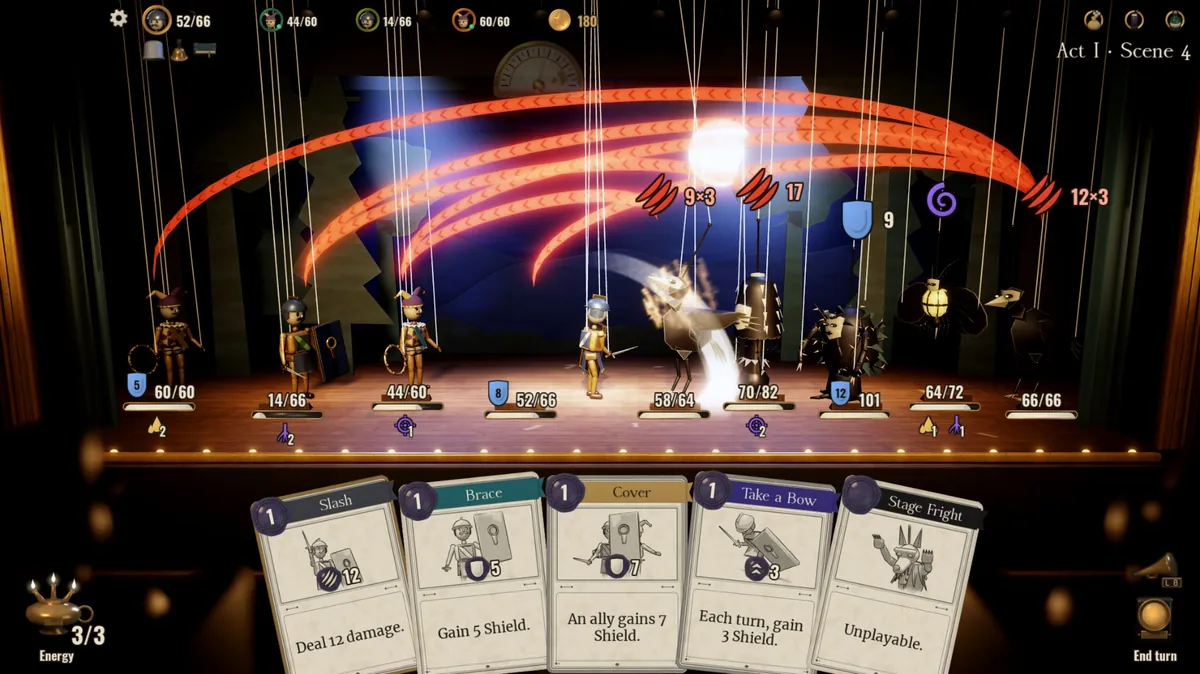
Four puppets against five enemies on the stage, each with its health, shield, statuses and next move, and a hand of five cards.
In-game capture: a party of four puppets against five enemies, the busiest moment of a fight.

Better together

One to four players on one shared turn, a team applause meter, five fixed pings that need no typing, a lift where parties form and an open casting call for those who want company.

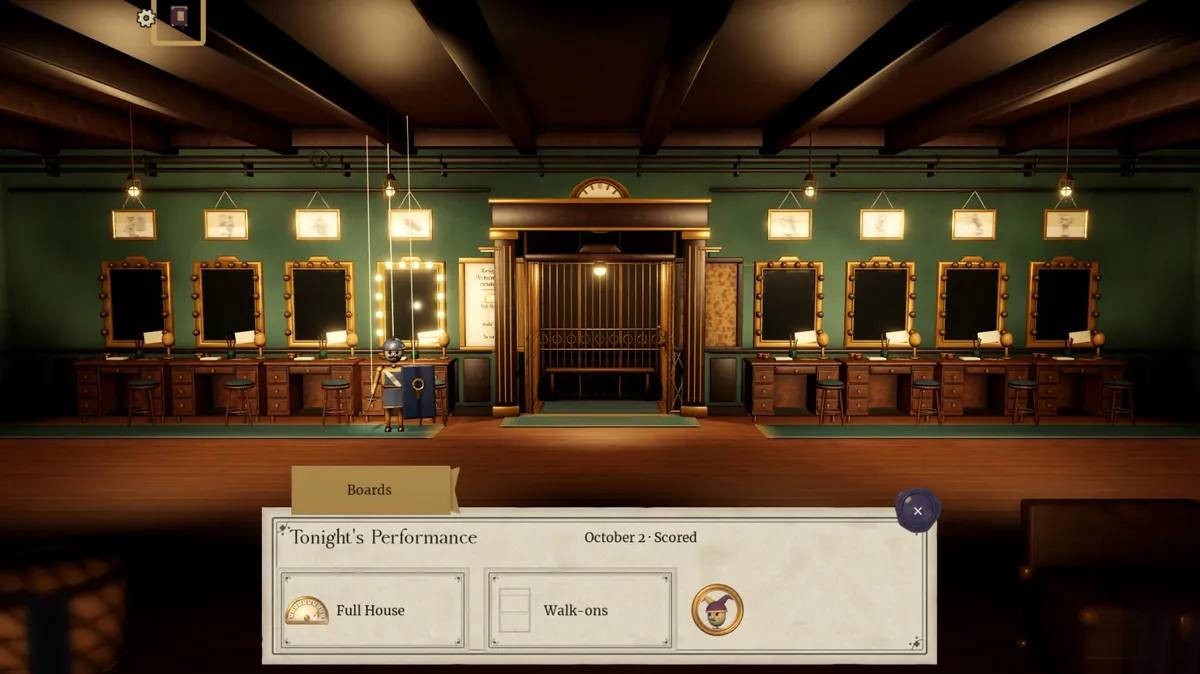
A dressing room with a row of lit mirrors and a puppet at one of them, and a paper notice reading Tonight’s Performance with two stage directions, Full House and Walk-ons.
In-game capture: Tonight’s Performance: one show a night, with its stage directions.

One show a night, the same for everyone

The Daily Show gives every player of a party’s size the same performance, one scored attempt each per day, with boards by night and size. The weekly revue, the lift’s third way down, is a whole performance of both acts with the week’s cast, the same for every party of a size from Monday to Sunday, with one scored try a week and boards of its own. A season is a calendar in data: the first, the Midwinter Bill (26 October 2026 to 3 January 2027), brings six stage directions of its own, a garland in the dressing room and a free track of five cue lights earned by nights and revues played, with dates and never a countdown. Add a scrapbook, three editions of cards, six feats and a streak of nights and weeks played that never decays: missing one costs nothing.

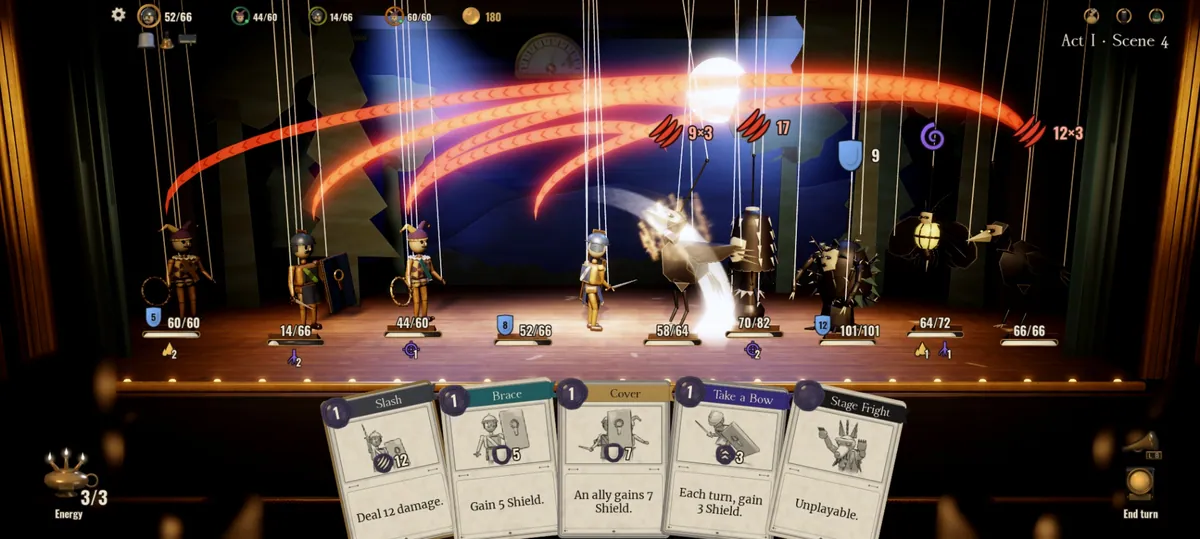
A landscape phone screen with four puppets, five enemies and a hand of five cards.
In-game capture: the phone layout in landscape: four puppets against five enemies, the hand readable at that size.

Everyone can play

Touch, mouse and keyboard, gamepad and a console’s ten-foot interface, laid out for phone, tablet, PC and TV: roomy taps, a safe margin on TVs, a pad’s own glyphs, a left-handed layout, one-handed controls, an interface size from 80 to 150 %, keys and pad buttons you can remap, a night mode, mono audio and six switches that mute a family of sounds. Text sizes, a high-contrast option, sound captions that stay off until asked, reduced motion, colour-vision palettes and a first-launch sheet of setups for vision, hearing and comfort, an easier Rehearsal mode and a named assist, the Prompter, for a gentler way down, with English and French for everything.
In the box

What you get, and what you do not.

Included

  • The whole game as a Rojo project: its code, its tests and every data file, as plain Luau you can read, unobfuscated, with an advisory licence check that never blocks anything
  • Every Roblox id the game uses in one file (your copy keeps the art’s Open Use ids; every other id is blank) and every balance number in another, with the bands the balance simulations hold the game to
  • Cards, enemies, encounters, props, tricks, scenes, stage directions, feats and the texts in both languages as data files you can read and change
  • What keeps a game alive: the Daily Show and a weekly revue with their boards, a scrapbook, a welcome back, a two-tap feedback question with fixed reasons, anonymous analytics, release notes, and saves with migrations (ProfileStore, credited and licensed in the package)
  • A game that sells nothing: room for your own products and passes, and nothing wired to a purchase
  • The built art (34 models, three materials, 487 images), the Blender and Python scripts that made it, scripts that synthesise the game’s own sounds, and the tools that upload them to your own Roblox account
  • A gate that checks your copy in one command, with its test suites, twelve balance simulations and the place build (27 min 12 s from the unzipped download, timed as a buyer runs it; the quick check, 1 min 1 s)
  • Install and read-me guides, a licence, and a credits page for everything that is not ours

Not included, said plainly

  • The developer’s own model and sound uploads: their ids are 0 in your copy. The built art is in the place with its Open Use images, so it opens as the captures show; the game’s own 115 sounds are silent until you make them with the included scripts and upload them (three commands, then Roblox’s moderation), then grant them to your game in the Creator Hub, 45 ids at a time (INSTALL.md step 5). Making your own versions of the art is the long step: expect hours of Blender and upload time, plus Roblox’s moderation.
  • Your own experience, your Roblox account, its products and your Open Cloud API key: you create those.
  • The Creator Store audio files. The music and the rest of the sound are licensed recordings by other creators, loaded by their Roblox ids and listed with links in the credits.
  • The developer’s own store images and page texts.

Where to buy

Try it first, then buy it once.

Try it first

Play the live game

The game itself is free on Roblox, with its art built — the kit can be one release behind it.

Requirements

Tools
Roblox Studio and a Roblox account to play and publish it; to change it, a shell (Git Bash on Windows), Rokit and uv, and Blender 5.2 to remake the art; an Open Cloud API key to upload the sounds
Players
1 to 4 per party
Devices
Phone, tablet, PC, gamepad and console
Languages
English and French
Delivery
Sold and delivered by BuiltByBit; an optional licence key and a client-area copy; an advisory licence check
How delivery works
BuiltByBit sells and delivers Cutstring: you download the package from your BuiltByBit account and it works as it is. A licence key is optional: ask the developer for yours and your client area gives you a copy of the kit with the key already written in it. The kit carries an advisory licence check that only ever writes a line to your server’s output, and LICENCE_CHECK.md in the package says exactly what it sends.

How it was made

Said the same way here and on the listing.

Each BuiltByBit listing carries a disclosure about how its product was made. We reproduce it word for word, so this site never says anything the listing does not.

How it was made

The listing’s text

The game was designed and directed by its developer. The code, the tests, the Blender scripts and the game’s texts (the names, the cards’ and the enemies’ words, the lore, in English and French) were written by an AI coding assistant (Claude Code) under that direction, then checked by automated tests and a gate that runs on every change. No AI-generated image, texture or 3D model is inside the product: every visible object comes from a Blender script, the surface textures are CC0 libraries, the game’s own sounds are synthesised by scripts, and the music and the rest of the sound are licensed Creator Store recordings loaded by their Roblox ids (listed with links in THIRD_PARTY.md).

About the pictures

The listing’s text

Every picture on this page is a capture of the running game, taken through Roblox Studio; none is generated by an image model. The cover is one of those captures with its title set afterwards in a font of the game’s own style. The capture tooling cannot record play, so there is no gameplay footage: a trailer, if one is added, is a cut of these captures.

Questions

Before you buy.

Do I get the art?

Yes. The place opens as the captures on this page show it: 34 models, three materials and 487 images, drawn from the developer’s uploads that Roblox makes Open Use (anyone may use them in any experience). The game’s own 115 sounds are the one part Roblox never shares: you make them with the included scripts, upload them in three commands, then grant them to your game in the Creator Hub (a published game plays only the sounds it was granted). The package also ships the Blender and Python scripts that made the art, and the tools that upload to your own Roblox account, for when you want your own versions.

Can I play it before I buy?

Yes. The live game is free on Roblox: it is the game the kit is made from, with its art built. The kit can be one release behind it.

How was it made?

The developer designed and directed it. The code, the tests, the Blender scripts and the game’s texts were written by an AI coding assistant (Claude Code) under that direction, then checked by automated tests and a gate. No AI-generated image, texture or 3D model is inside the product. The disclosure further down is the listing’s own, word for word.

Is anything in it not made by you?

Yes, and it is named. The music and the rest of the sound are licensed Creator Store recordings by other creators, loaded by their Roblox ids, the surface textures come from CC0 libraries, and the package includes the ProfileStore library (Apache 2.0). The credits page lists all of it with links.

How much can I change?

Almost everything is data: every balance number is in one file, every Roblox id in another, and cards, enemies, encounters, props, tricks, scenes, stage directions, feats and the texts in both languages are files you can read and change. The code is plain Luau, and a gate checks your copy after each change.

What has not been proven?

As of the 1.5.0 listing (9 October 2026): the game has been played by its developer and by one outside player, it has no player numbers yet, and its balance comes from simulations, not from crowds. The simulations also list what is not fair yet: the Daily nights are still unequal (an Act II night’s head start has a floor, 4 seeds of 600 are still unwinnable for the expert bot, and the worst 5 % of nights are won under a third as often as the median) and a few pure draw cards are worth about as much to that bot as taking nothing; no card, prop or trick reads worse than nothing. The path from unzip to your own running experience has been run in parts, never as one session on another account, and the blank first launch was run on the first package only. The sound captions, the first-launch sheet, the high-contrast option and the six sound switches have been seen working in the engine by test jobs, never used by a person who needs them; the interface was audited by test jobs on a phone, a tablet, a PC and a TV, but the Largest text size and the one-handed layout were not audited again after the first versions and no real phone was used; the longest sessions were 25 and 18 minutes on early versions and showed a slow growth of the interface’s memory; and the weekly revue’s boards were checked in Studio’s in-memory boards, not in a real MemoryStore across servers.

Are the updates free?

Yes, for life, as on every Botera product. The listing’s support terms are the ones BuiltByBit shows on it.

Questions before or after you buy?

The developer answers on the Discord. There is no support queue and no reseller in between.